Written testimony provided on March 24, 2026.
Contact: Laura Lanese, President and CEO, Inter-University Council of Ohio
Phone: 614-537-3816
Email: [email protected]
Chairman Young, Vice Chairman Ritter, Ranking Member Abdullahi, and members of the Ohio House Workforce and Higher Education Committee, thank you for the opportunity to provide proponent testimony for House Bill 644.
My name is Laura Lanese. I serve as President and CEO of the Inter-University Council of Ohio (IUC). IUC represents Ohio’s 14 public universities, which collectively educate the majority of students pursuing higher education in Ohio.¹
Our institutions serve every region of Ohio and are deeply connected to the employers, industries, and communities that drive Ohio’s economic growth. Ohio’s public universities educate the talent pipeline that powers our advanced manufacturing growth, healthcare workforce, defense innovation, and emerging technology sectors. Increasing degree completion rates is critical to Ohio’s workforce and economic competitiveness. It is with that in mind that the IUC thanks Representative Manning for her leadership on this important topic.
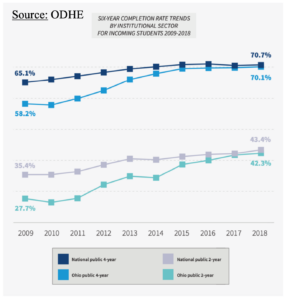
House Bill 644 establishes a new evidence-based innovation fund for Ohio’s state institutions of higher education focused on student outcomes and degree completion. The proposed framework ensures that any public or private dollars are directed toward initiatives with demonstrated successful outcomes. This legislation reflects a growing recognition that student outcomes and degree completion is as important to the student and their family as it is to our state’s economic wellbeing. According to the Ohio Department of Higher Education’s (ODHE) 2024 Attainment Annual Report, student completion rates have jumped from 50.5% in 2009 to 65.2% in 2018, the most recent full cohort year available in ODHE’s longitudinal reporting. During that same period, Ohio’s public four-year universities have made tremendous progress to catch up to the national average—jumping from a 58.2% completion rate in 2009 to a 70.1% completion rate in 2018.²
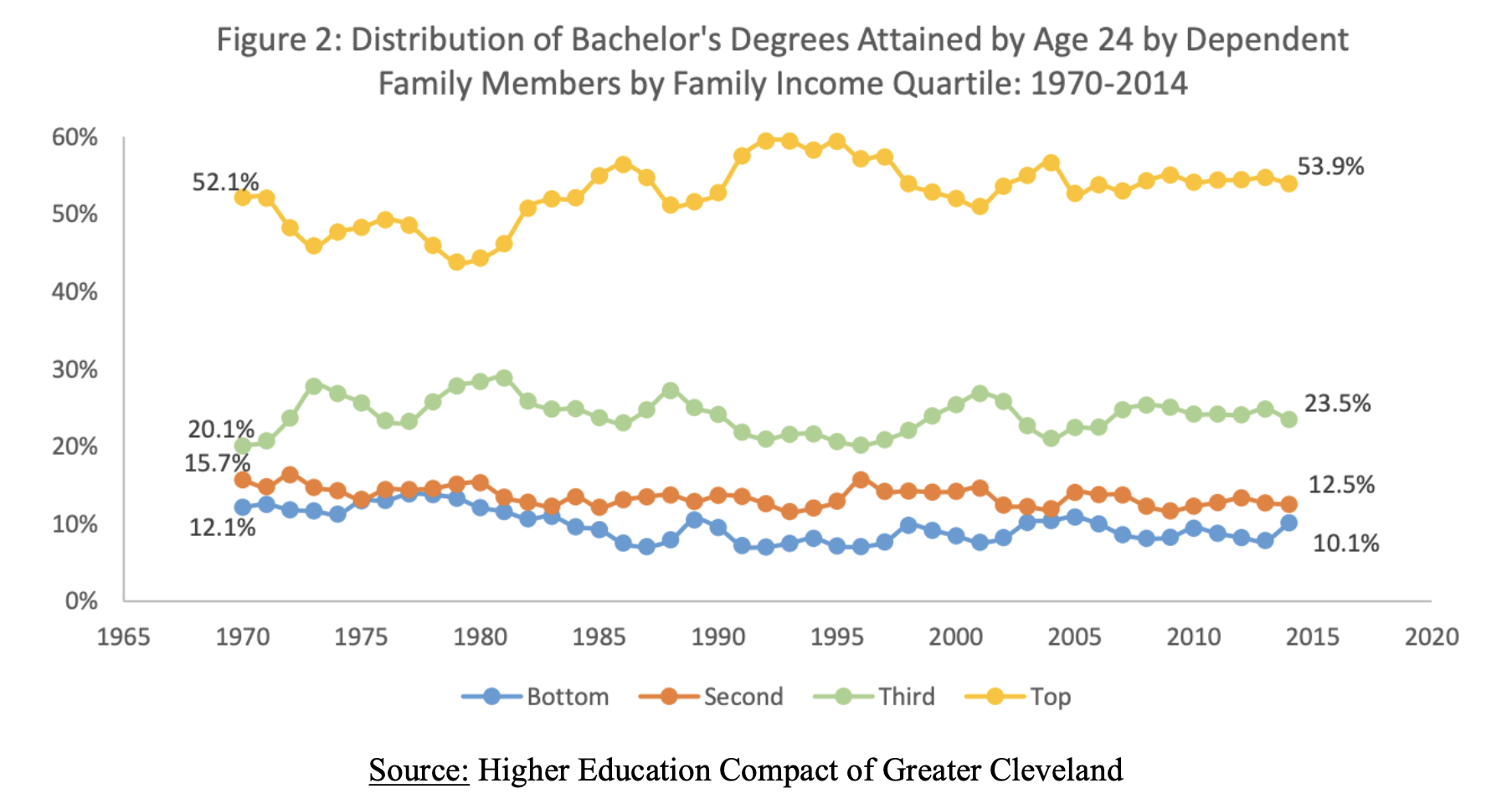
While Ohio has made great strides in promoting student outcomes and degree completion, there is still more work to be done. If Ohio is serious about strengthening our workforce readiness, talent retention, and economic competitiveness, we must continue to invest in strategies that increase graduation rates. This bill places a particular emphasis on helping low-income students. Historical data shows that students coming from low-income households are significantly less likely to achieve a college degree.³
What makes HB 644 especially compelling is its focus on evidence-based practices and measurable outcomes. The bill requires grant applicants to:
- Present research supporting the proposed intervention;
- Establish annual benchmarks;
- Demonstrate plans for program sustainability and rigorous evaluation;
- Show how the initiative will increase completion rates; and
- Emphasize collaboration across two-year, four-year, and workforce systems.
While no appropriation is currently attached to the fund, the legislation creates a mechanism capable of accepting both public and private dollars. With interest in providing private funds already expressed by philanthropic partners, the type of public-private partnership envisioned in this legislation positions Ohio to leverage outside investment while maintaining strong state oversight.
The IUC believes Ohio’s public universities are well-positioned to compete for and implement these types of evidence-based reforms. Our institutions already operate a wide range of student outcomes initiatives, from co-requisite remediation reforms to guided pathways and enhanced advising models. HB 644 would provide an opportunity to scale what works and rigorously evaluate new approaches.
To conclude, Ohio’s public universities stand ready to partner with all public and private stakeholders to strengthen degree attainment and student outcomes statewide. HB 644 is a thoughtful framework to encourage innovation, accountability, and measurable results. The legislation offers Ohio the opportunity to become a national leader in scaling evidence-based reforms while strengthening our state’s workforce pipeline.
____________________________
¹ https://nscresearchcenter.org/final-fall-enrollment-trends/
² https://highered.ohio.gov/data-reports/data-and-reports-sa/reports/2024-attainment-report
³ https://highereducationcompact.org/wp-content/uploads/2022/10/College-Affordability-in-Ohio-FINAL.pdf